
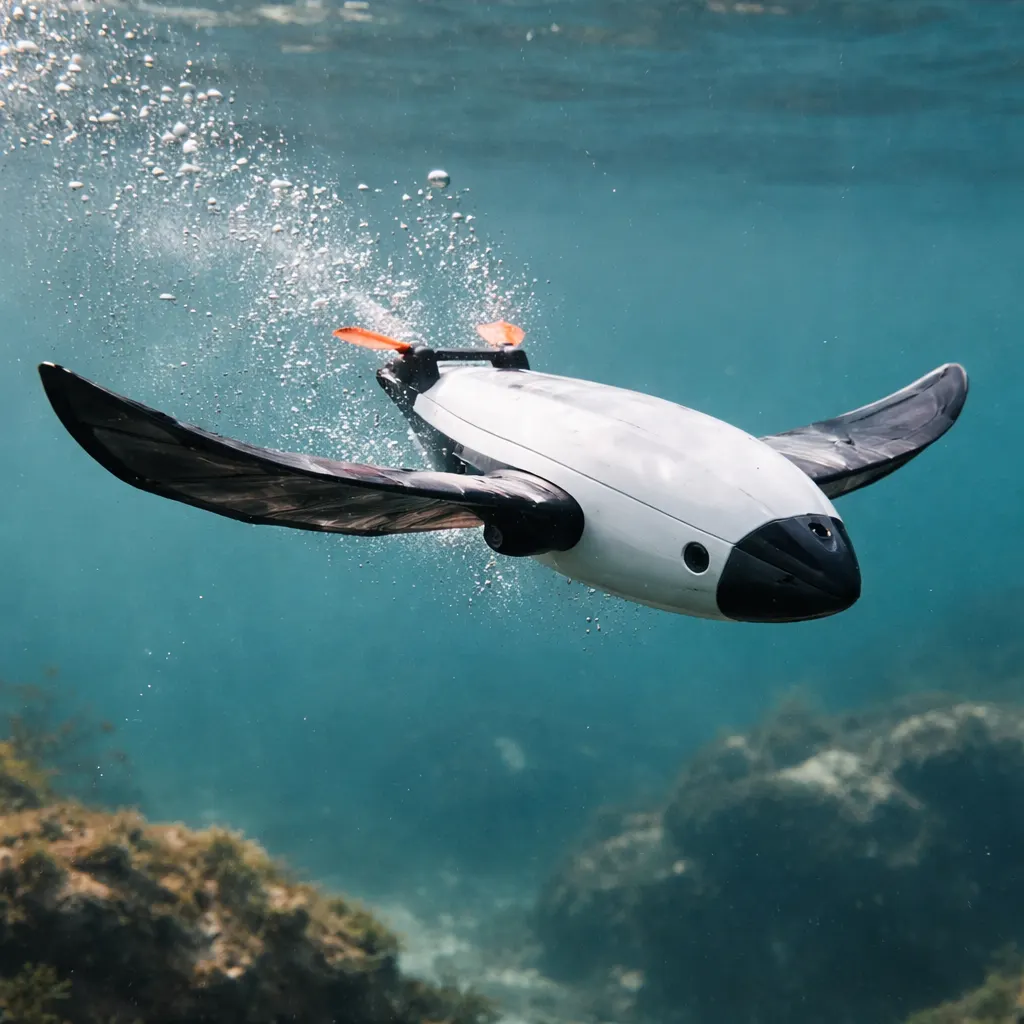
Engineers at MIT and EPFL in Switzerland have built a robot that can dive underwater, swim, and then leap back into the air to fly—mimicking birds like gulls and puffins that move between two radically different environments. The "flapping-wing aerial-aquatic vehicle," detailed in a report published October 20, 2026, weighs less than 300 grams and represents what researchers say could become a new category of ocean exploration drones. The device features a central body, two bendable wings, and a tail that can change angles, all powered by a waterproof electric motor.
The robot's design incorporates thin wing membranes treated with water-repelling nanoparticles to shed moisture quickly, according to the report. During trials conducted in a water tank and at Lake Geneva, a research group headed by Raphael Zufferey, an assistant professor of mechanical engineering at MIT, pinpointed specific combinations of wing dimensions, flapping speed, and tail positioning that allowed smooth shifts from swimming to flight. Medium-sized wings delivered optimal performance—flexible enough to reduce flapping motion in water while stiff enough to maintain aerial stability. The device operated at speeds and flapping rates comparable to real birds, and a tail pitch of 70 degrees—a fairly sharp upward angle—enabled the transition from water to air. Surprisingly, the machine needed no feet to launch from the water's surface, even though many diving birds use their feet to paddle during takeoff.
"Our dream vision is for oceanographers, marine biologists, and members of coastal communities to launch this robot from a boat, or from shore," Zufferey states. The robot would fly near targets like icebergs, port infrastructure, or whale pods, plunge into the water to gather measurements or samples, and return to transmit information "at a fraction of the cost of traditional methods," he says. According to Zufferey, one major challenge in ocean science involves collecting information both regularly and across numerous sites—something this robot could accomplish in the future. "You could send this out not just every week, but every hour," he notes, describing a cycle where the device flies out rapidly, dives, returns with data, and repeats the sequence multiple times.
The engineering team is now working to create wings capable of turning in addition to flapping, the report says. They plan to evaluate how the robot handles turbulent environments, including rough seas and windy flight conditions, before deploying it to tackle questions in ocean research. The ability to operate in both water and air solves a fundamental problem: traditional vessels can't safely reach many aquatic zones of scientific interest, from Arctic ice shelves to sensitive marine habitats. By combining flight speed with diving capability, the robot could sample locations far more frequently than current methods allow, the researchers say. The battery and crankshaft mechanism that drives the wings up and down at fixed frequencies makes the half-pound machine light enough to stay airborne yet durable enough to withstand repeated water entries—a balance that could redefine how scientists monitor coastal and polar regions. For organizations operating on tight budgets or in remote areas, the promise of hourly data collection without deploying crewed boats or large autonomous vehicles represents a step change in both cost and flexibility. Though the technology still requires refinement under real-world stress, the dual-medium design opens pathways that neither conventional drones nor underwater probes can access alone.