
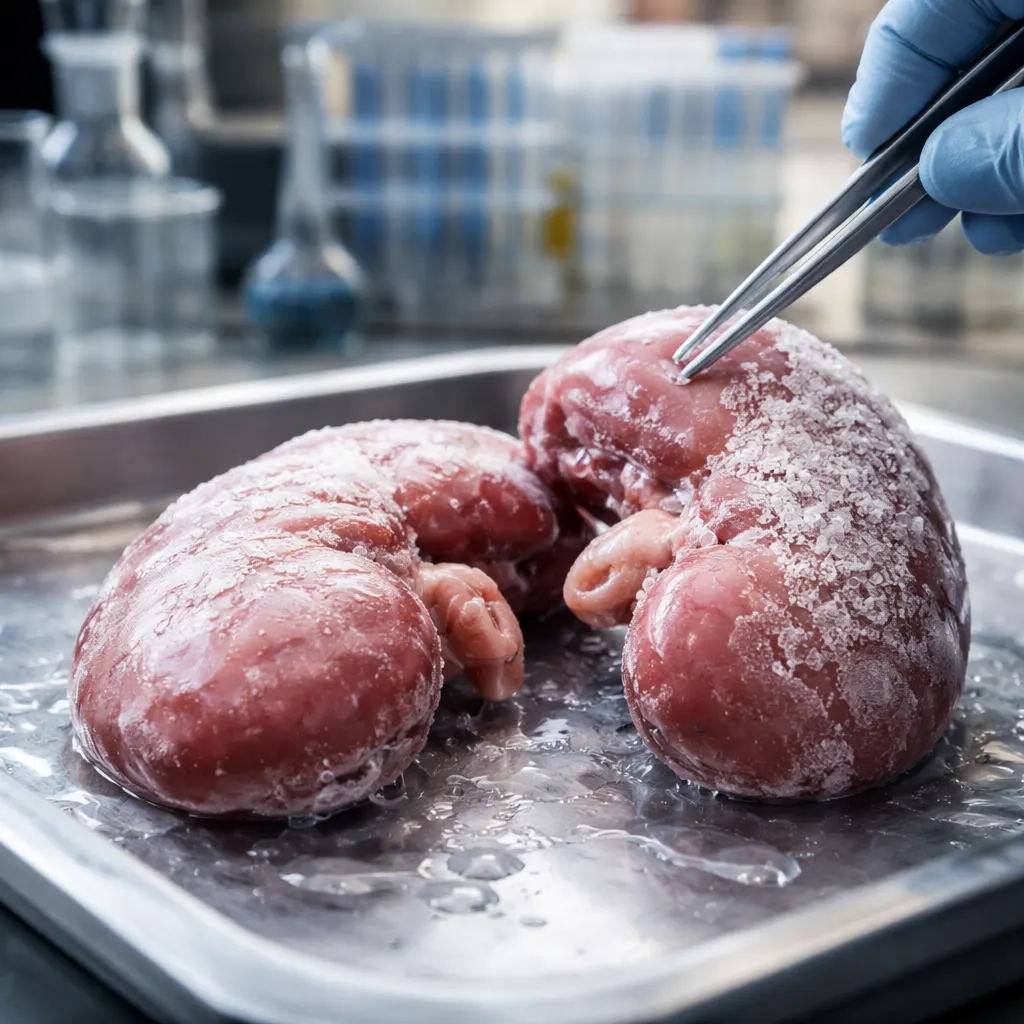
Scientists have successfully frozen pig kidneys at -150 °C for more than a year, then rewarmed and restored them to working condition, according to research shared on bioRxiv in October 2026. The work, led by transplant surgeon Erik Finger and bioengineer John Bischof at the University of Minnesota, marks the first time whole mammalian organs have been brought back from long-term deep-freeze storage. The kidneys—similar in size to human organs—were preserved in a glass-like state through a process called vitrification, then tested on machines and transplanted into live pigs, where they regained color and produced urine.
The rewarmed kidneys performed well by key measures, though not perfectly. When transplanted into pigs and monitored for two hours, the organs produced urine within a minute, though at roughly two-thirds the volume normally expected. Most tested kidneys had been stored for days or weeks, but one organ banked for just over a year produced urine immediately upon rewarming and "actually looked better than many of the [other] kidneys," Finger said. The organs showed blood flow and color recovery—critical signs of function—but also displayed injury believed to stem from the toxic cryoprotectant chemicals used in preservation.
"After we did the last transplant, I walked out of the room and said, 'This is a big deal,'" Finger said of the achievement. The team used iron oxide nanoparticles infused into the organs to enable uniform rewarming via electromagnetic fields—a technique they first demonstrated with rat kidneys in 2023. Scaling up to pig kidneys, which weigh roughly 100 grams compared to one gram for rat organs, required three years of work to modify the cryoprotectant cocktail. External experts called the findings a breakthrough: cryobiologist Peter Kilbride said "finally, we've got this breakthrough" after years of failed attempts, while Harvard's Korkut Uygun declared "it is a revolutionary time for transplantation."
Long-term organ banking could reshape the transplant system by giving doctors more time to match organs to recipients and prepare patients' immune systems to reduce rejection risk. Currently, human organs must reach recipients within 24 to 36 hours of removal, and transplant patients face lifelong immunosuppressant drugs that increase infection and cancer risk. Tens of thousands of organ transplants occur annually in the US alone, and these procedures have saved an estimated 2 million years of life over the past 25 years, according to the research. Indefinite storage would allow "the organs that are waiting for the patients" rather than the reverse, Finger explained. Kevin Myer of Texas-based organ procurement organization LifeGift envisions banks of on-demand organs for emergencies like overdoses or gunshot wounds.
The team plans longer-term tests in pigs and experiments with human kidneys, while acknowledging hurdles remain. Cryobiologist Greg Fahy, a field pioneer, noted the damage raises questions about whether the kidneys could sustain life long-term, though he acknowledged it's unclear how they'd perform over extended periods inside living animals. The researchers believe less toxic cryoprotectants and repair strategies—including perfusion machines that have improved transplant organ health in other studies, or natural self-repair once inside a body—may address the injury. Finger suggested human kidneys might tolerate the process better than pig organs. "We're going to see that there's injury, and it's not perfect ... but now we've got to the point where it works," he said. The procedural complexity and toxicity trade-offs underscore why organ preservation has remained one of medicine's most stubborn technical challenges, while the proof of concept suggests bioengineering solutions may finally be catching up to clinical need.