
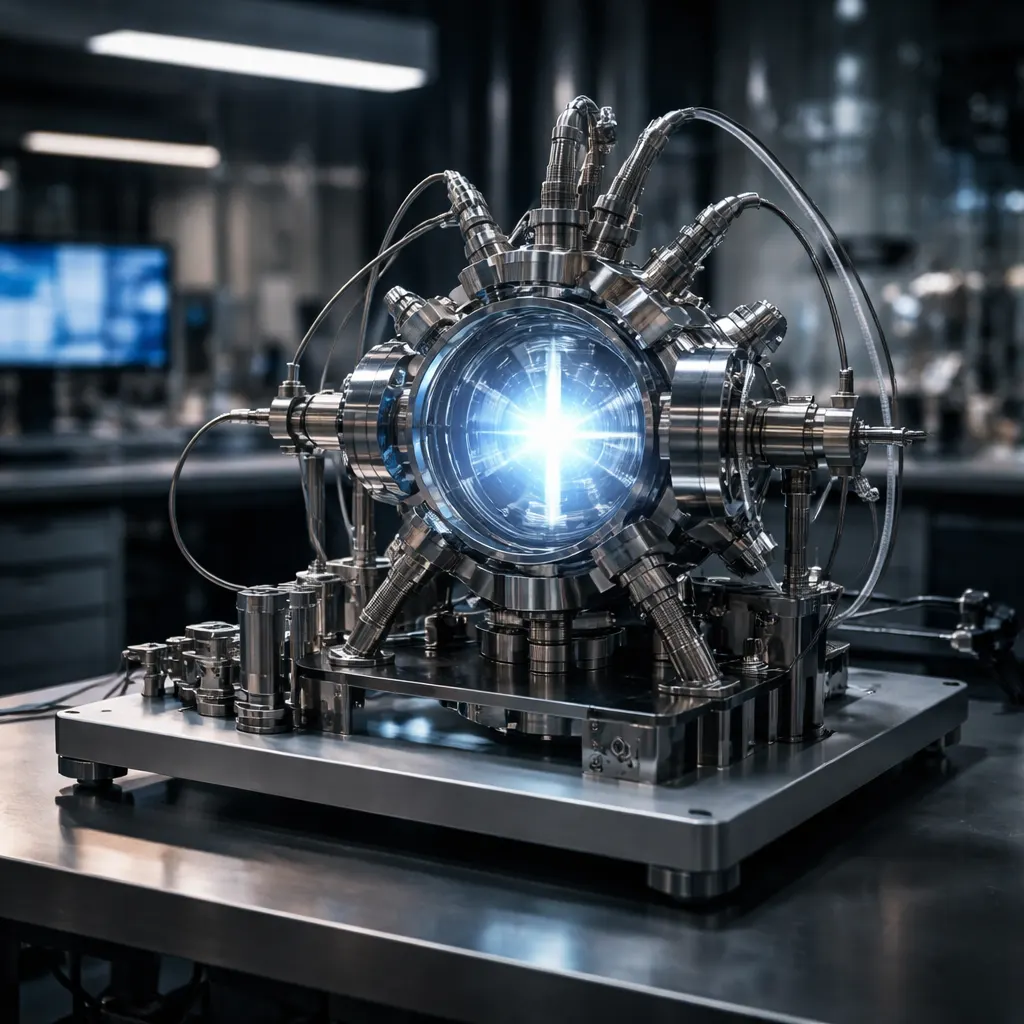
A Massachusetts startup has developed a fusion reactor that fits on a desk, a stark departure from the massive facilities typically associated with fusion power. Cambridge Heavy Industries, operating in stealth near MIT, recently revealed its benchtop device and announced a $6.2 million seed round led by Azolla Ventures, with backing from Overlay, Neta Foundation, P3A, MassCEC, and the Rothrock family. The compact reactor uses lasers to compress fuel targets, enabling the team to run 50 to 80 experiments daily.
The company's design minimizes the number of lasers needed to trigger fusion reactions. One laser splits into multiple beam lines that deliver light in concentric rings, which strike a flat, round fuel target in succession from the outside inward. Each ring launches a compression wave through the target, with subsequent rings timed to amplify the wave and further squeeze the fuel. When the shock wave hits the center, a laser fires to generate heat and a magnetic field, creating conditions for fusion. The approach produces high pressures with relatively modest laser power, according to co-founder and CEO Yun Kai. The technology emerged from MIT chemist Keith Nelson's lab, where researchers used laser pulses to study materials under extreme conditions and discovered they were approaching fusion-ready pressures.
Cambridge Heavy plans to use its smaller devices to manufacture tritium, a rare hydrogen isotope essential for nearly every fusion power plant currently in development. The substance sells for around $30,000 per gram, and only about 40 kilograms exist worldwide today. Each power plant will need just grams of tritium annually, yet one recent study forecasts a shortage of roughly 28 kilograms by 2054—worth approximately $840 million at current prices. Kai noted that fusion startups are designing fuel systems to make reactors largely self-sufficient for tritium, though that process could take up to a decade. In roughly ten years, the company aims to scale up to a power plant about the size of two basketball courts to test whether the concept can generate sufficient energy for commercial operation.
The compact design allows Cambridge Heavy to iterate rapidly, with data from daily experiments feeding AI-driven simulations that refine the reactor's performance. Because the device is small and modular, the team can test adjustments quickly without the cost and complexity of operating a full-scale facility. The benchtop prototype addresses a critical bottleneck in fusion development: the ability to experiment frequently and cheaply while the industry waits for tritium supplies to catch up with demand. Tritium production could provide years of revenue as Cambridge Heavy pursues its larger power plant, positioning the startup to both supply the fusion industry and develop its own commercial reactor. For investors and industry watchers, the dual-path strategy represents a pragmatic hedge in a field where technical breakthroughs rarely translate immediately into profitable energy generation. The real test will be whether a design optimized for speed and simplicity can scale without sacrificing the physics that make tabletop fusion possible in the first place.