
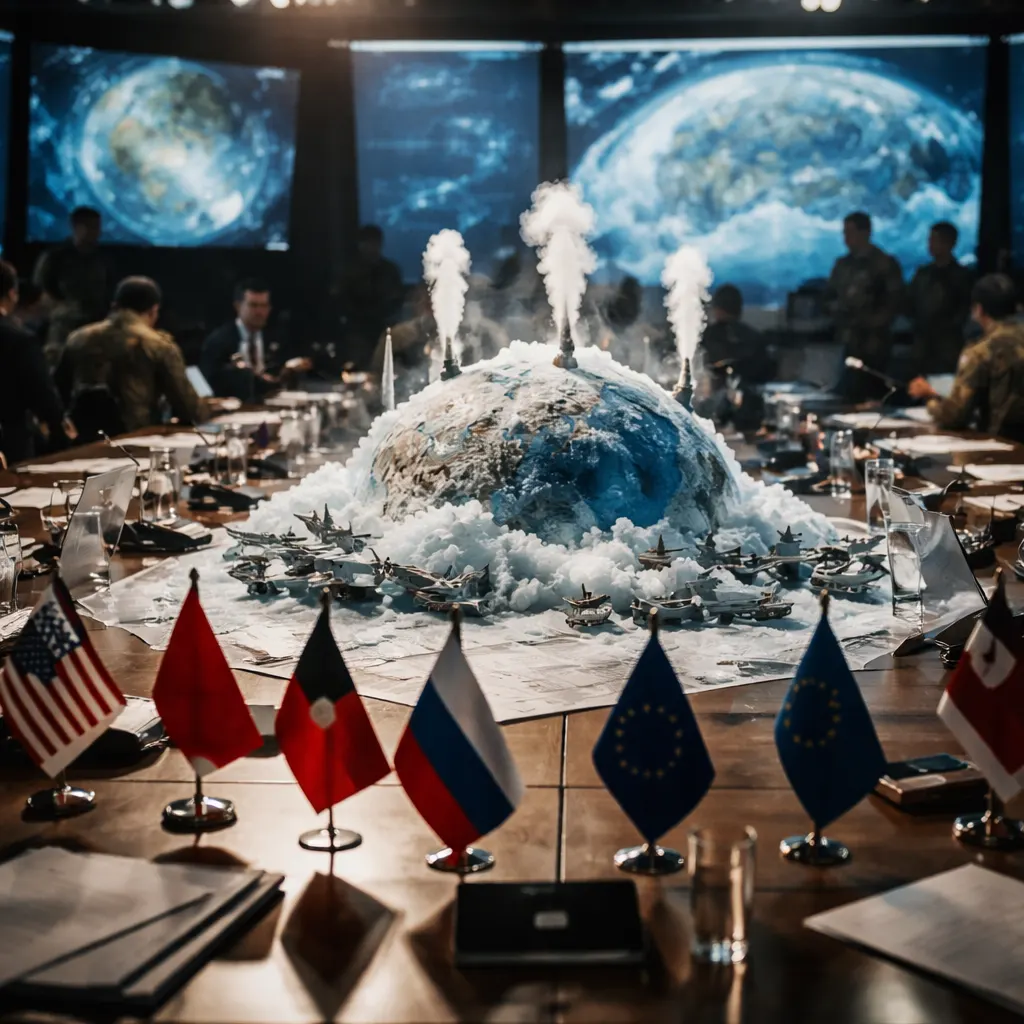
A first-of-its-kind war game simulation held in London last September revealed that nations would likely abandon climate science and trigger a dangerous arms race if solar geoengineering technology becomes viable. The exercise, titled Exploring Geopolitical Tipping Points and Climate Cooling Strategies, brought together roughly two dozen foreign-relations experts, scientists, military personnel, and former government officials at Queen Mary University of London. Participants concluded that strategic competition and state sovereignty, not climate concerns, would dominate international response to technologies designed to reflect sunlight and cool the Earth.
The simulation unfolded across three sessions representing September 2024, September 2027, and September 2028, with escalating stakes at each stage. Players representing the United States and China both refused to sign any international agreement that would limit research they deemed in their national interest or allow their superpower competitor to gain a technological advantage. During the first session, Russian delegates received an intelligence report about a suspected US geoengineering plane near the Bering Strait, which the Americans dismissed as disinformation even though they were actually conducting research flights. The US then became convinced China was secretly developing its own program after Beijing tried to insert language protecting past experiments from retroactive punishment and approached SpaceX about sharing technology. Countries abandoned negotiations entirely, with Canada's representative calling it "a humiliating defeat." The simulation's final report stated that "strategic competition and state sovereignty drove the simulations, not climate concerns."
Scientific expertise was almost entirely disregarded throughout the three-day exercise, according to participants. Climate researcher Colleen Golja, who was assigned to provide technical advice, watched as political posturing dominated while climate disasters and weather modeling went largely ignored. When a major plume of aerosols was detected during the final day—caused by a joint US-Saudi test in the game—countries finally sought scientific help to establish a monitoring network. An NGO called the Climate Futures Cooperative offered Golja funding for such a scheme, but the group turned out to be backed by the fossil fuel industry, deliberately undermining her credibility. The organizers designed this twist to reflect how fossil fuel companies and major producing nations would have clear motivation to support technology that fights climate change without requiring immediate cuts to coal, oil, and gas burning. Jeffrey Nielsen, a US Army major who played an American national security attaché, told reporters that any action by one superpower "can be perceived as malintent by the other," adding that the threat of falling behind a rival is "a very strong driver of research and development of capability."
Solar radiation modification technologies aim to reverse global warming by reflecting a portion of sunlight away from Earth, typically through spraying particles like sulfur dioxide into the atmosphere. The cooling effect would replicate what happens after large volcanic eruptions, which can temporarily lower global temperatures by half a degree or more. However, the consequences are unevenly distributed: models predict drying across sub-Saharan Africa and more powerful tropical storms in the Atlantic. The cooling would last only as long as the geoengineering continued, after which temperatures could surge back up with unpredictable and potentially catastrophic results. What was once a speculative niche of climate science has moved rapidly toward commercialization, with US-Israeli startup Stardust Solutions raising $60 million last year and releasing details of inventions it claims would let humans adjust global temperature at will. In August, Elon Musk endorsed solar geoengineering on X, writing that "space satellites to control temperature and massive geo-engineering will be needed or it will be game over."
The simulation was organized by Danielle Young, an assistant professor in international relations at Leeds University, with sponsorship from the UK government-funded Advanced Research and Invention Agency. Cynthia Scharf, a former UN advisor who played the US government role alongside Nielsen, told reporters that "scientifically transparent international collaboration" between China and the US "might be the best we can do in terms of fending off a very dangerous competition between the two." She added she couldn't imagine such cooperation happening under the Trump administration. The game's lack of any international agreement mirrors real-world developments: in March, two conservative US think tanks urged the Trump administration to seize the lead on solar radiation modification and counter China's threat, coining the term "weather sovereignty." This month, Britain's Ministry of Defense was revealed to have funded research into sunlight reflection, and the British government released its first official policy paper supporting further study but firmly opposing deployment. After witnessing the simulation's breakdown, Golja plans to return to her small Connecticut coastal town to help local groups build seawalls and erosion buffers rather than pursue science aimed at informing global decisions. The experience left her concluding that in a world driven by narrow geopolitical self-interest rather than evidence and reason, making a difference "where it feels like I actually have traction" matters more than chasing international consensus. The technology's rapid shift from academic theory to commercial product means policymakers will face governance decisions within the next decade, not 15 years away, creating pressure to act before the science or diplomacy can catch up.