
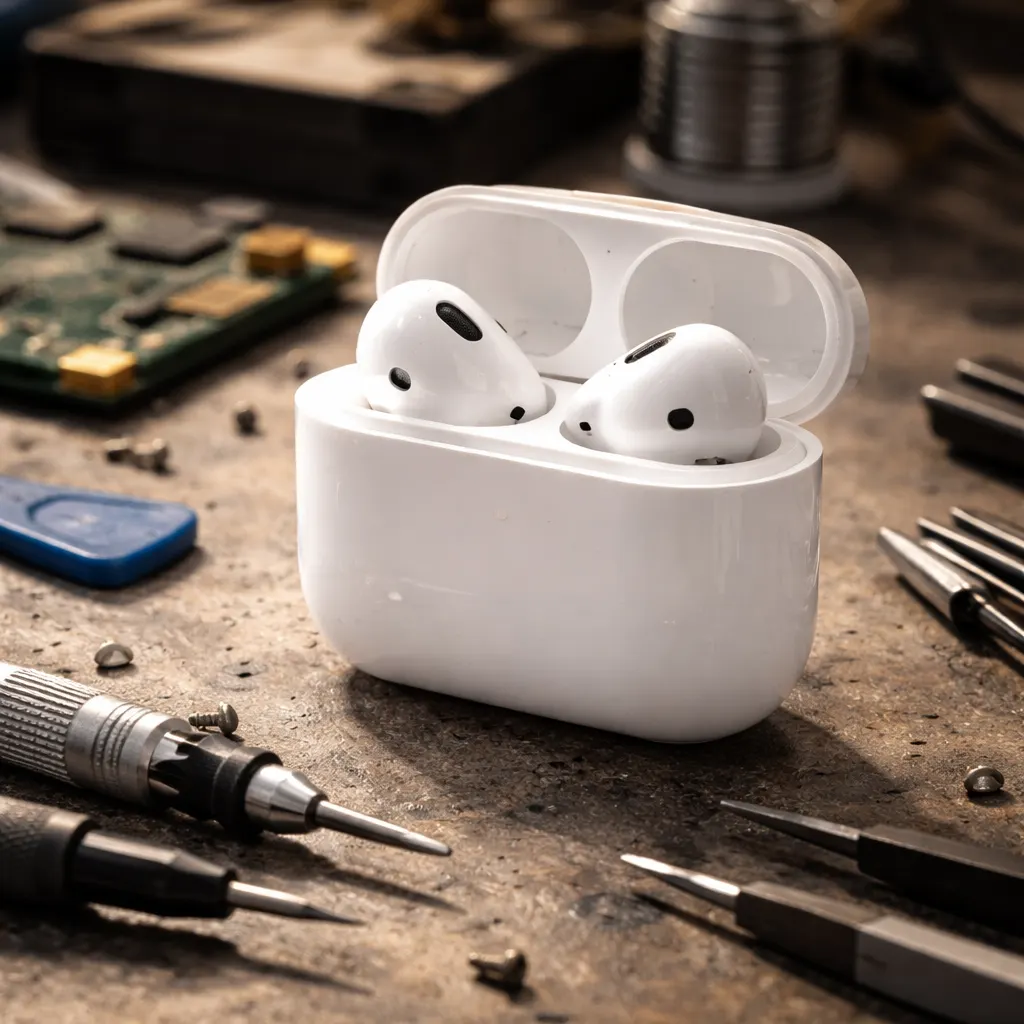
Apple's newest AirPods earned a repairability score of two out of ten, a marginal improvement over the zero rating awarded to every previous generation tested by iFixit. The latest entry-level earbuds, which launched with the iPhone 18 Pro and Duo, represent the first time the product line has allowed battery replacement without completely destroying the device. While still far from genuinely repairable, the AirPods 5 mark a small shift in Apple's approach to hardware longevity.
The AirPods 5 share the design of earlier models, featuring short plastic stems, no silicone tips, and a USB-C charging case, with wireless charging available for an additional cost. The earbuds now include IP57 dust and water resistance. Inside, skilled technicians or determined do-it-yourselfers can now swap out batteries because they use removable prongs instead of soldered leads, and the buds open with standard tools. A clamp, a hair dryer on its lowest setting, careful heating, and patient prying were sufficient to open the earbuds cleanly without destruction. After removing adhesive strips, the pronged batteries popped out. However, replacement batteries aren't yet available, and the left and right earbuds use subtly different batteries with reversed polarity and off-center welded prongs, making them non-interchangeable. Deeper disassembly revealed a capacitive touch layer on the wireless charging version and the H2 system-in-package that powers active noise cancellation.
The charging case remains effectively unrepairable and resisted all attempts to open it without damage, the teardown team reported. The process involved prying, cursing, cutting, more cursing, and an accidental stab wound, ultimately requiring complete destruction of the case to extract the battery and components, making reassembly impossible. "It simply shouldn't be this hard to get to a battery," the team noted, pointing to Fairphone's Fairbuds as an example showing that battery replacement can be prioritized in both earbuds and their cases. With no replacement parts or repair manuals from Apple available, combined with a charging case that can't be opened intact, the result remains distant from genuine repairability. Even so, iFixit characterized the AirPods 5 as "not as disappointing as they could have been," awarding them the highest score the product line has ever received.
The modest improvement matters because previous AirPods generations forced consumers to discard entire devices when batteries degraded, a problem inherent to products sealed with aggressive adhesives and soldered components. The pronged battery design enables removal without specialized equipment or permanent damage to circuitry, lowering the technical barrier for repair shops and ambitious users. However, the absence of official replacement parts and documentation means Apple hasn't committed to supporting third-party repair, leaving the door open but not providing a path through it. The charging case's continued impermeability to non-destructive disassembly underscores that the design priority remains compactness and aesthetics over serviceability, with batteries sealed behind layers requiring cutting tools and accepting injury risk to access. The two-out-of-ten score reflects this tension: technically possible repairs don't equal practical ones when parts don't exist and half the product remains off-limits. The case's design approach suggests Apple views the charging case as a disposable component despite housing a lithium battery subject to degradation over time. For consumers and repair advocates, the battery prongs represent acknowledgment that repair access has value, even if implementation falls short of competitors willing to sacrifice millimeters of thickness for user serviceability. The broader stakes involve e-waste reduction and consumer rights to maintain products they've purchased, areas where incremental change from a market leader can shift industry norms over time.