
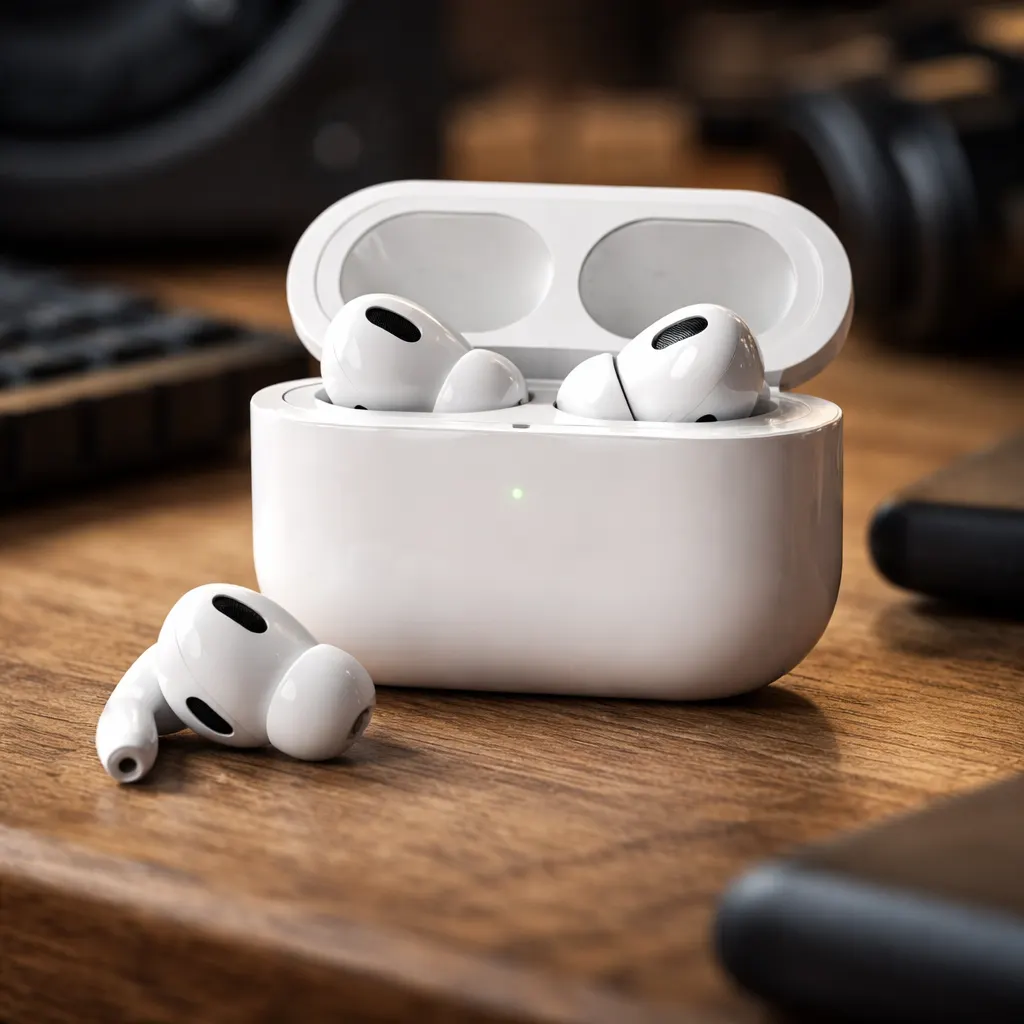
Apple's AirPods Pro 3 delivered the strongest overall noise cancellation performance in controlled laboratory tests, blocking an average of 35.81 decibels across the full audio spectrum, according to new testing published by ZDNET. The tech publication examined active noise cancellation (ANC) capabilities of earbuds from Apple, Bose, Sony, and other major brands in a Kentucky-based lab facility. The tests aimed to measure how well each product reduces controlled external noise across frequency ranges that mirror real-world conditions.
The AirPods Pro 3 performed strongest in canceling both mid-range sounds at 36.16 dB and high-frequency treble at 30.17 dB. Sony's WF-1000XM6 earbuds finished second overall with 33.89 dB reduction but claimed the top spot for blocking bass frequencies at 36.41 dB. Bose QuietComfort Ultra earbuds landed in third position, trailing the Sony model closely. At the bottom of the rankings, JBL Tour Pro 3 and Sennheiser Momentum True Wireless 5 earbuds recorded the weakest scores, with the Sennheiser pair managing just 17.01 dB of bass reduction—the lowest measurement across all frequency bands tested.
The testing setup used four speakers arranged in a diamond formation to generate pink noise, creating what engineers call a diffuse sound field that better reflects how sound reaches human ears in everyday environments. At the center sat a miniDSP EARS Pro fixture—a device with silicone-molded "ears" and high-quality microphone couplers that mimic human ear canal geometry. Senior lab engineer Bryan Adams explained the device "mimics the diffusion of the vibrations that make up the sound across an actual ear canal and ear geometry," though he acknowledged it's not a perfect representation of an eardrum. Each earbud pair was tested with ANC turned on, with real-time frequency data captured in decibels and then averaged across three bands: bass (60-200Hz), mid (200Hz-2kHz), and treble (2-8kHz). Equipment limitations meant data below 40 Hz or above 8 kHz wasn't useful, but the publication notes the vast majority of daily noise falls within the tested range.
Active noise cancellation works by using built-in microphones to detect surrounding sounds and generate an exact opposite sound wave—what engineers call anti-noise—that cancels out background noise. The technology, first released in consumer earbuds in 2000, has evolved significantly over the past two decades. Hybrid systems now use microphones both inside and outside ear cups to detect a broader range of external noise, making cancellation stronger but sometimes affecting sound quality. Adaptive noise cancellation takes this further, employing computer algorithms to assess the environment and automatically increase cancellation when entering noisier spaces. All headphones also rely on passive noise cancellation—the simple physical blocking of sound by covering ears—which requires no technology at all.
ZDNET cautions that individual experiences with these earbuds may differ from lab results based on external environment, how the earbuds fit in each person's ear, and other variables. However, the publication positions its testing as expert analysis providing a baseline for how effectively various models handle ANC. The report emphasizes that lower-performing earbuds in these tests aren't necessarily poor products overall, but simply didn't block frequencies as well as competitors in this specific controlled environment. For professionals working in noisy offices, frequent travelers, and others seeking to eliminate unwanted sound, the differences between top and bottom performers span nearly 20 decibels—a gap that translates to noticeably different listening experiences. The dominance of premium models from Apple, Sony, and Bose suggests that effective noise cancellation remains a feature where brand engineering investment yields measurable returns, though the gap between flagship and mid-tier options continues to narrow as the technology matures across the industry.