
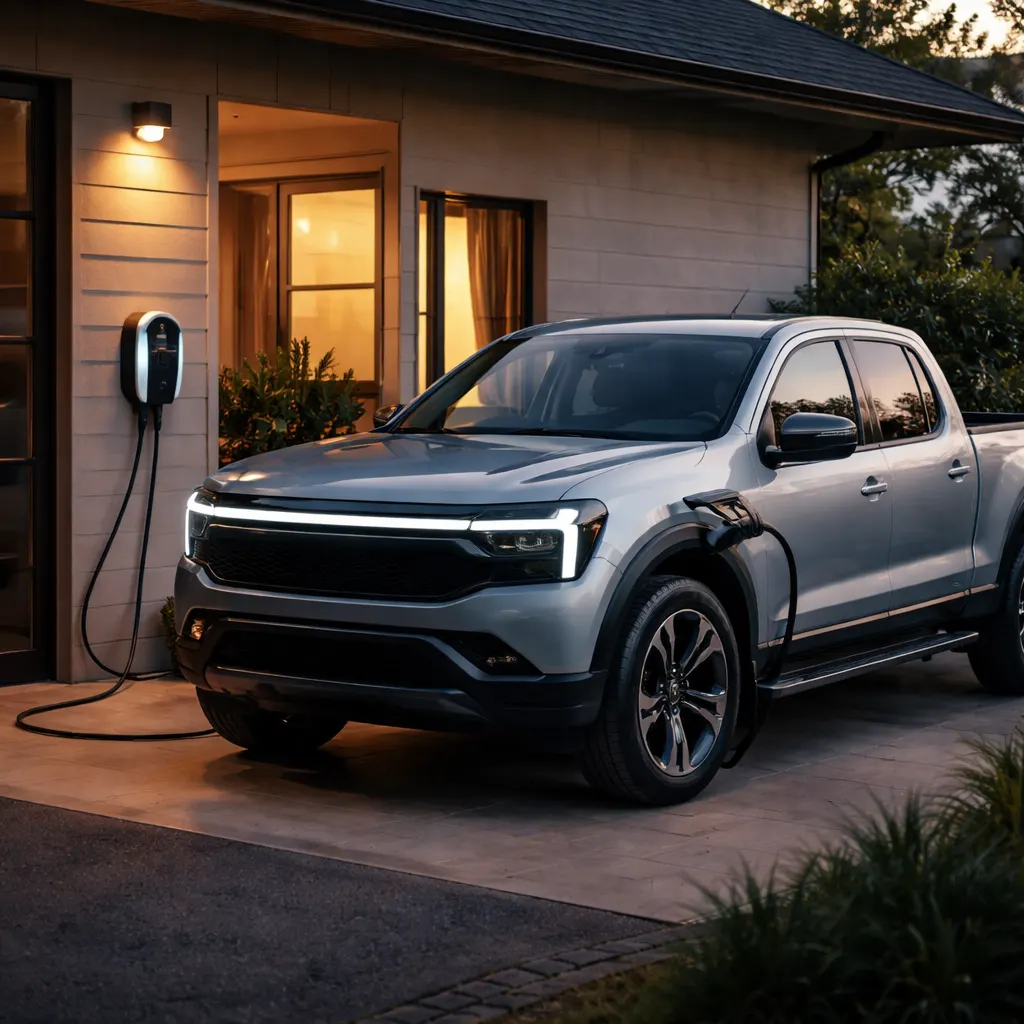
Ford announced two new electric vehicle chargers today that will enable its upcoming Fathom pickup truck to function as a battery supplying electricity to homes or the electrical grid. The automaker revealed the Fathom itself will carry a starting price of $28,350, while the new charging devices promise to cost roughly half what Ford's current equivalent products do. The company says this price reduction could extend the technology's reach to a broader range of households.
The Fathom will be able to supply more than 10 kilowatts of electricity to a residence, according to Ford. That output would let the electric vehicle replace a compact backup generator. For a typical American home, that capacity wouldn't run all systems simultaneously, but it could maintain operation of a refrigerator and air conditioning unit for approximately twelve hours. The Home Power Station device will retail for around $650, representing about a 50% price drop compared to Ford's first-generation bidirectional charger. The alternative option, Home Backup Power, packages the Home Power Station together with a second component called the Home Backup Panel to enable the Fathom to energize portions or the entirety of a residence during electrical outages. Ford says this bundle will cost approximately $2,100, roughly 60% less expensive than its first-generation offering. Neither price figure accounts for installation expenses, which for existing vehicle-to-everything chargers can reach as high as $10,000, depending on the electrical modifications required to ready the home.
The Home Power Station device can assist customers in reducing their electricity bills by charging the Fathom during periods when power rates are low and returning electricity to the residence when rates climb higher, the automaker says. Both charging systems will permit Fathom buyers to take part in virtual power plants, which employ software to manage a network of distributed energy storage units such as electric vehicles. Fathom owners who sign up and maintain their truck connected to the grid can sell electricity back to utilities, frequently at premium rates. Ford didn't specify potential earnings for Fathom owners, but the report notes compensation can exceed $1,000 annually, contingent on grid requirements and participation levels.
This capability has been promoted as an edge electric vehicles hold over vehicles running on fossil fuels, but relatively few EVs arrive with proper equipment, and the chargers necessary to enable vehicle-to-everything services typically carry steep costs, according to the report. Which electrical loads the Fathom can energize will differ by household and the particulars of each setup, the report explains. Equipment like air conditioners and refrigerators, for instance, generally demand a substantial surge of electricity to start operating, after which their consumption decreases. Devices known as soft-start units can help reduce the initial surge, though they add expense to the installation. As pressure on the electrical grid intensifies due to artificial intelligence data centers, power companies have been investigating whether virtual power plants can help ease congestion at network endpoints.
The Fathom-powered virtual power plant represents Ford's newest entry into the energy storage market, though it's not expected to be the company's final one, the report states. Automakers including Ford have been exploring energy storage more deeply as demand for these services climbs. The combination of a sub-$30,000 electric pickup with significantly cheaper bidirectional charging hardware could make home backup power and grid participation economically viable for households that previously found the technology prohibitively expensive. Ford hasn't revealed partnerships with installation contractors, though a company spokesperson told the publication that additional details would be shared later. The bidirectional charging ecosystem remains fragmented across manufacturers and requires specialized electrical work, creating barriers that competitive pricing alone may not fully resolve.