
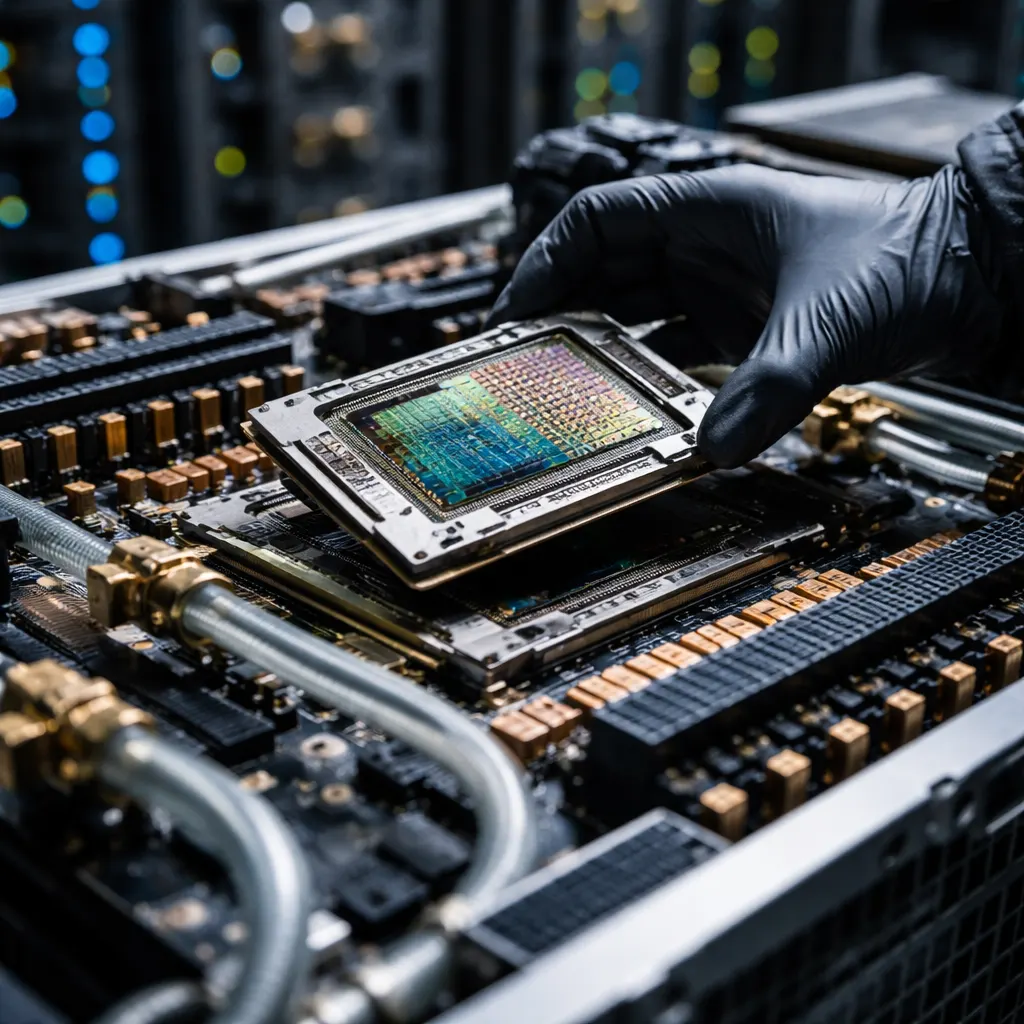
The US Department of Energy has installed a second cluster of NextSilicon's Maverick-2 accelerators at Los Alamos National Laboratory, marking a significant expansion of the agency's relationship with the Israeli chip startup. The deployment was announced during Supercomputing 2026 in Chicago on Monday, just six months after Sandia National Laboratories powered on NextSilicon's first supercomputer. The move positions Los Alamos to evaluate whether runtime-configurable chips can handle the lab's most demanding workloads, including nuclear deterrent simulations and fusion reactor modeling.
The newly deployed system comprises just four accelerators, considerably smaller than Sandia's 64-node cluster featuring 128 of NextSilicon's chips. Despite its compact size, the system sits within Darwin, a long-lived testbed environment at Los Alamos designed for evaluating emerging technologies. According to LANL chief scientist Galen Shipman, the smaller footprint allows the lab to validate and port a wider range of codebases to the chips, identify issues, and work directly with NextSilicon to shape future chip capabilities. Hands-on access is critical because many of Los Alamos' most sensitive workloads can't run on public systems. NextSilicon has validated its systems against the High Performance Conjugate Gradients benchmark, the LAMMPS molecular dynamics test suite, and the Sparta Monte Carlo simulation suite. In HPCG, a single Maverick achieves 600 gigaFLOPS of performance, which the company says matches contemporary GPUs at half the power consumption.
Shipman explained that Los Alamos' interest represents "the first step toward larger scale deployments of NextSilicon silicon in future DoE supers." The lab's focus on multi-physics simulations, such as inertial confinement fusion experiments, presents a particular challenge because these aren't single workloads but multiple simulations with wildly different compute requirements. CPUs excel at workloads with large serial sections and irregular access patterns, while GPUs handle dense matrix multiplication efficiently, but finding one platform optimal for all phases of a multi-physics simulation is difficult. "Where NextSilicon fits in is being able to reconfigure to match the workload, on demand," Shipman said, adding that the hope is to avoid rigid upfront determinations about how much CPU or GPU capacity is needed. Rather than advertising peak theoretical performance like traditional GPU vendors, NextSilicon CEO Elad Raz noted that the company publishes performance figures across a range of HPC benchmarks because Maverick-2's roofline performance varies from one workload to another.
The accelerators employ a dataflow architecture that overlaps communication and computation, using a grid of arithmetic logic units configured to perform operations like addition or multiplication in the order they're needed. Data is computed as it moves from one unit to the next, making the design extremely efficient in bandwidth-constrained scenarios with implications for both scientific computing and AI inference. NextSilicon's designs have been specifically tailored toward sparse double-precision FP64 workloads, and the company claims to have developed a compiler that can decompose existing C, Python, Fortran, or CUDA codebases into a graph that runs directly on its chips. Shipman told The Register that peak advertised performance is rarely a useful proxy for real-world results, saying his team focuses instead on generating representative proxies and kernels that communicate Los Alamos' needs so vendors like NextSilicon can co-design with them. The Darwin testbed deployment positions the lab to determine whether reconfigurable architectures can deliver the adaptability needed for the nation's most critical simulation workloads. For organizations running heterogeneous compute environments, the tension between specialization and flexibility will only intensify as workloads fragment further. Whether runtime reconfigurability can bridge that gap at scale remains the central question NextSilicon must answer to move beyond testbeds.