
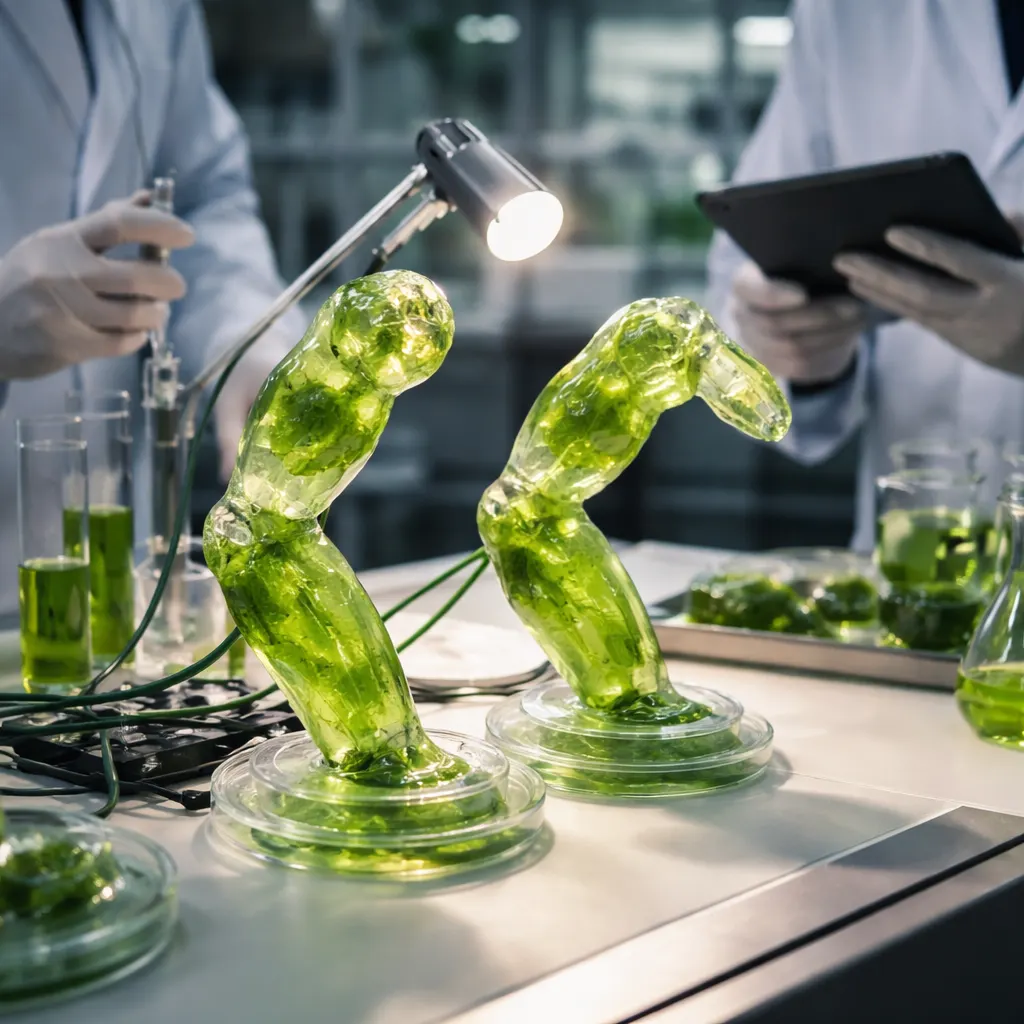
Researchers at Delft University of Technology in the Netherlands have created soft robotic arms covered in living algae that move when exposed to light, using the microorganisms' photosynthetic activity to generate mechanical motion. The team developed what they call bioactuators, which harness the functions of living cells rather than electricity or heat to create movement. The research represents a proof of concept for soft robots that require no external energy beyond light and no complex mechanical parts.
The robotic arms measure roughly three-quarters of an inch in length and are approximately as thick as a credit card, built from two hydrogel layers that host algal cells on their surface. One layer responds to pH changes driven by the algae's metabolism: when light hits the algae, photosynthesis begins, absorbing carbon dioxide and fixing nitrogen to make the local pH more basic, causing the responsive hydrogel to swell. In darkness, the algae release carbon dioxide through respiration, shifting the pH back to acidic and making the hydrogel shrink. The pH-responsive layer changed dramatically with algal activity, dropping to about 37 percent of its original weight in acidic conditions between pH 3 and 7, but swelling to quadruple its original weight at pH 11. The chemical shift starts quickly—roughly 20 seconds after light exposure and about 10 seconds after darkness—but the hydrogel takes several hours to bend significantly. The team built a four-fingered gripper that closes under light, successfully grasping and lifting a hollow metal sphere before releasing it when the light turned off, and a hook-shaped gripper that could pick up and set down a rubber ring.
According to Marie-Eve Aubin-Tam, who led the research, the team didn't begin with a specific application but aimed "to bring the research of living materials to new levels" and explore what becomes possible when living cells are integrated into functional materials. Aubin-Tam noted that microalgae are plantlike organisms that are largely self-sustaining, giving the actuator potential for long-term operation with minimal external input, and that in theory, it wouldn't require much energy to run a system based on this technology. The report notes that while other researchers have built soft robots responding to pH, they typically must alter the chemistry of all surrounding liquid, whereas the photosynthetic activity in these algal bots has a much more local effect, making them better suited to applications where minimal environmental impact is essential.
The researchers say their photosynthetic approach offers advantages over conventional soft robots because the algae need no genetic modification, eliminating the biosafety concerns often tied to microbe-based technologies. In fact, the machines are exceptionally environmentally friendly, since the organisms can absorb carbon dioxide from the atmosphere while pulling energy from sunlight. Looking ahead, the research team hopes this work will contribute to developing more autonomous, environment-responsive soft robots for use as automated agricultural equipment, for fluid control in lab-on-a-chip devices, or as part of any underwater robotics system. The main limitation remains speed: these aren't fast robots, taking hours for significant bending, but their dexterity in grasping extremely light objects shows promise for delicate manipulation tasks where metal actuators would fail. The marriage of living organisms and engineered materials may reshape how industries think about powering robotics in resource-constrained or ecologically sensitive environments. Self-sustaining biological systems could challenge the assumption that automation must always depend on batteries or grid power.