
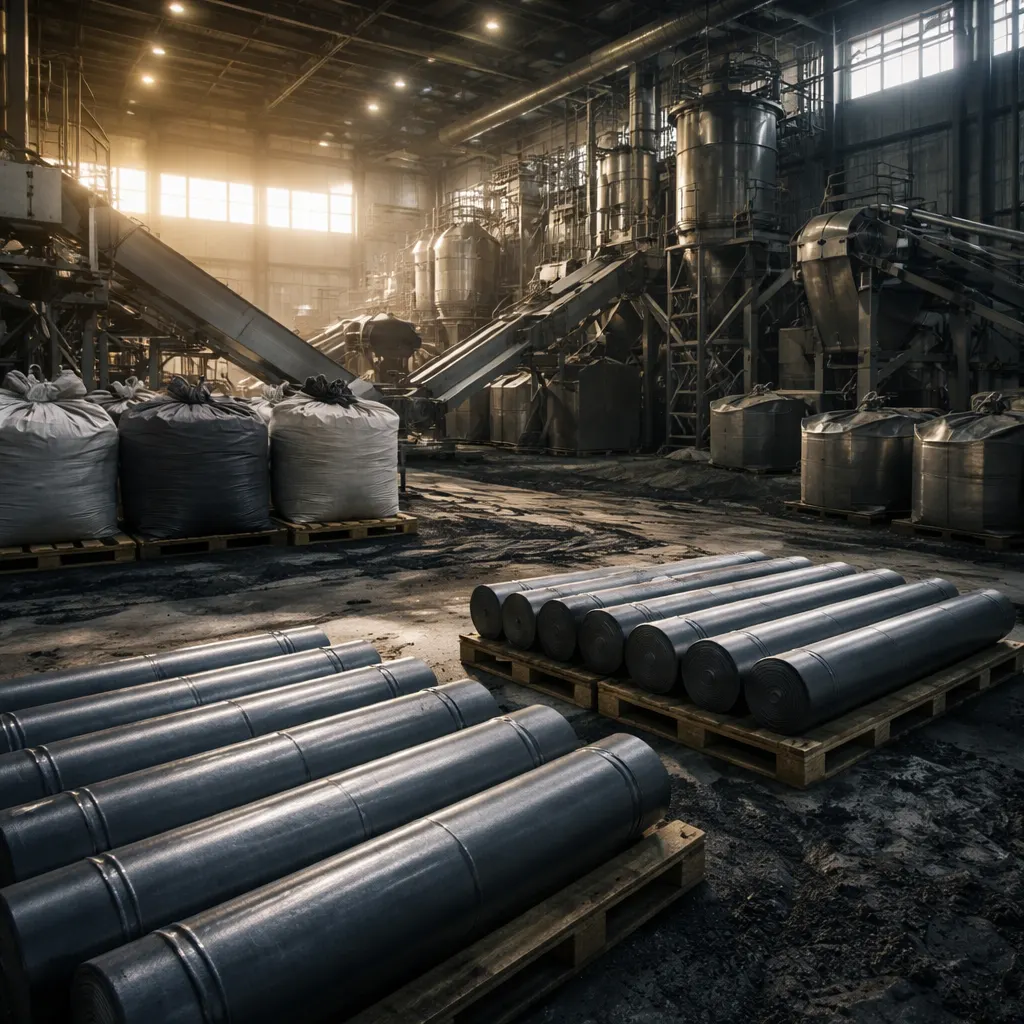
A five-year-old company has begun running a demonstration facility in Oakland designed to prove it can produce battery-grade graphite at prices that match Chinese imports once tariffs are added, according to an exclusive report published by TechCrunch on November 18. Molten Industries aims to crack China's near-total control over synthetic graphite anodes, a critical component that stores charge in lithium-ion batteries. The company's technology uses natural gas and electrical heating to split methane into pure carbon and hydrogen, a process it claims requires three times less electricity than existing methods.
Chinese companies command roughly three-quarters of the graphite anode supply chain and 97% of synthetic graphite anode production globally, according to data from Benchmark Mineral Intelligence cited in the report. The U.S. battery market has quintupled over the past five years, even as electric vehicle sales have plateaued. Molten's Oakland facility will produce approximately 300 metric tons of graphite each year, sufficient to supply batteries for around 4,300 electric vehicles or 300 megawatt-hours of storage capacity. Most of that output will be shipped to undisclosed customers testing the material in their battery cells.
"The new plant will be producing graphite that's at cost parity with China plus tariffs," Caleb Boyd, Molten Industries' co-founder and chief technology officer, told TechCrunch. Future facilities should match China's cost even without import taxes, he said, calling it "a built-in advantage of the technology." Kevin Bush, who co-founded the startup with Boyd and serves as CEO, said the company isn't trying to replicate Chinese manufacturing processes. Instead, Molten is leveraging cheap and plentiful U.S. natural gas with new technology to lower production costs worldwide, Bush explained.
The startup's approach began in a Silicon Valley garage, where the two Stanford materials science PhDs initially set out to make clean hydrogen from natural gas without the pollution caused by steam reforming, the dominant method today. They planned to sell leftover carbon as a byproduct. But as they solved technical problems that had plagued earlier attempts to heat methane without oxygen—particularly carbon buildup clogging the reactor—they discovered they were producing high-quality graphite that "changed the entire economics" of their work, Boyd said. The process uses electrical resistive heating, which Boyd compared to "a massive toaster," to break each methane molecule into one carbon atom and four hydrogen atoms. The hydrogen atoms combine into hydrogen gas, which Molten sells to a neighboring customer at market rates, while the carbon is refined to meet battery specifications.
Molten shifted from a hydrogen producer that happened to make graphite into a battery-grade graphite manufacturer that happens to sell hydrogen. The company claims both lines of business could generate billions of dollars in revenue. If Molten supplied America's entire battery market, it could also deliver roughly one-third of the hydrogen consumed domestically, the company estimates. Additional applications for premium graphite, including thermal batteries that store energy as heat, could expand both markets further. Boyd described the new factory as "a milestone, not just for the company, we think, but globally." The company plans to replicate the Oakland plant's design multiple times over at its next facility, which hasn't been announced yet. For battery makers and automakers watching China's dominance over critical minerals, the question isn't whether alternative supply chains are technically possible but whether they can scale fast enough to matter before geopolitical tensions reshape the entire market.