
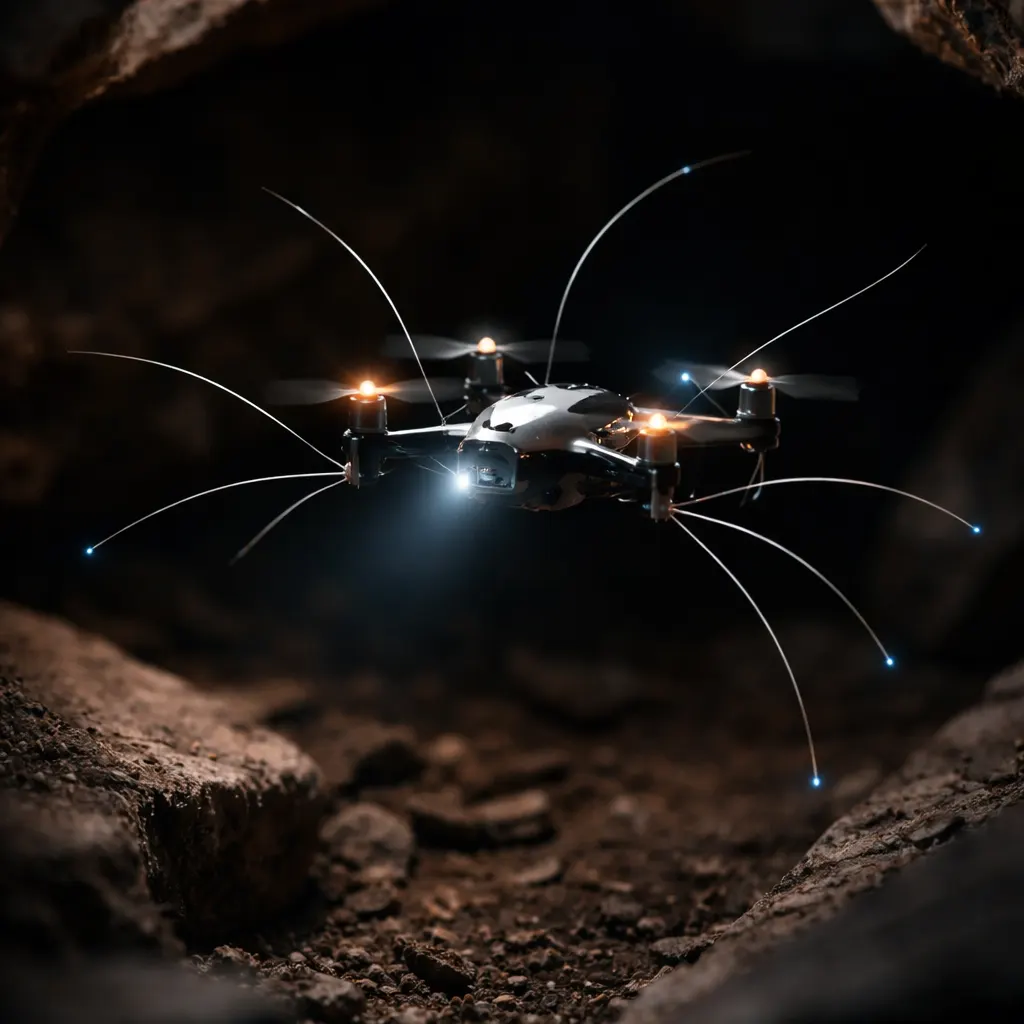
Researchers at Delft University of Technology have developed lightweight tactile sensors that allow ultra-compact drones to navigate in complete darkness, according to a study published by WIRED. Drawing inspiration from nocturnal animals like mice and cats that rely on whiskers to explore their surroundings, the team created artificial whiskers from nickel-titanium wire that enable palm-sized drones to sense obstacles when cameras and lidar fail. The breakthrough addresses a critical limitation in disaster rescue operations, where smoke-filled buildings or nighttime conditions render traditional sensors useless.
The whiskers consist of delicate nickel-titanium wires measuring 0.4 millimeters in diameter—roughly the thickness of four sheets of paper—with each whisker extending nearly 8 inches in length. Three small pressure sensors at the base measure wire bending, allowing the drone to calculate its distance from and position relative to nearby barriers. All navigation calculations run on a microcontroller aboard the drone without external computing support. In testing, the drone successfully maintained a distance of 60 to 100 millimeters from wall surfaces and located a 2.5-foot-wide exit in a small room with glass walls in 90 percent of trials. The entire tactile perception system uses just 34 KB of memory out of the drone's available 192 KB capacity.
The research team compared 72 flights across six different mounting angles at three speeds to determine optimal whisker placement. According to Salwa Hamaza, a professor at Delft University of Technology, "For tactile sensing to work on drones, it needs to be lightweight, low-latency, and low-power." The 45-degree mounting angle was ultimately selected because it produced the least deviation in the drone's orientation, though 30-degree and 60-degree angles also allowed incident-free flight. Chao-Shan Ye, a doctoral student on the team, noted the system demonstrates "that touch does not have to come at the cost of size or computational power."
Developing functional tactile navigation required overcoming multiple engineering challenges that don't exist in nature, since whisker-navigating animals generally don't fly. Long protrusions create instability—when moving along a wall, resistance from the whisker could cause the drone to rotate and crash. Distinguishing genuine contact signals from propeller vibrations proved difficult, with initial testing showing 38 percent of detections were false positives. The team addressed this through a correction algorithm that continuously estimates sensor drift trends based on readings when the drone isn't touching anything. Combined with filtering, false positives dropped to 0 percent. The researchers also encoded an exploration method that prioritizes unexplored areas by probabilistically estimating wall shapes, preventing the drone from getting stuck in corners or missing side barriers.
The technology offers immediate applications for disaster scenarios where ultra-compact drones weighing less than a stick of butter must navigate collapsed structures but lack the compute and power capacity for robust sensors. The drone successfully navigated walls positioned at angles, something laser-equipped models cannot accomplish, and transparent glass surfaces that visual systems can't detect. The minimal memory footprint leaves substantial capacity for additional capabilities. For organizations deploying rescue drones, the choice between sensor redundancy and payload capacity just shifted fundamentally. Tactile navigation may prove less about compensating for vision's failure than about accessing spaces where vision was never an option.