
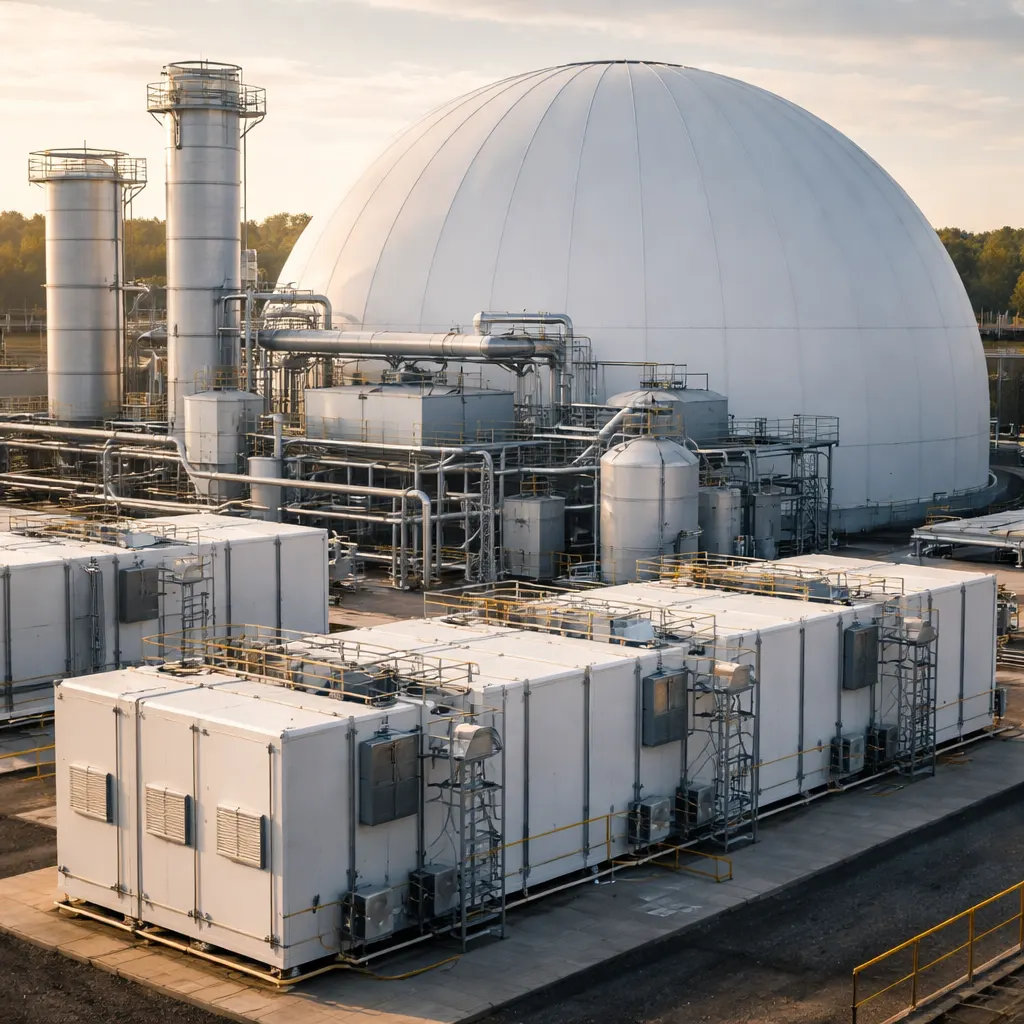
An Italian startup has built grid batteries that store electricity for up to 24 hours using compressed carbon dioxide, offering a cheaper alternative to lithium-ion for long-duration energy storage. Energy Dome, profiled in MIT Technology Review's 2026 climate tech companies to watch, turned on its first commercial facility in Sardinia, Italy, in 2025, and the publication highlights how the company's approach could help grids worldwide balance renewable energy supplies that fluctuate with weather patterns.
The Sardinia plant holds a 200-megawatt-hour capacity—sufficient to run roughly 18,000 Italian households for 10 hours—and uses a massive white dome spanning an area equivalent to seven soccer fields that contains about 2,000 metric tons of carbon dioxide. When surplus energy flows in from sources like solar farms, compressors squeeze the gas into liquid form and store it in carbon-steel tanks, while the heat generated during compression gets captured in a proprietary thermal storage material. Later, when the grid demands electricity, the stored carbon dioxide gets released from the tanks and heated with the captured warmth, expanding back into gas that drives a turbine to produce power before returning to the dome to repeat the cycle. The company estimates its technology runs roughly 10% to 15% cheaper than lithium-ion batteries for eight-hour storage systems, with even better economics for durations extending to 24 hours.
The report notes that Energy Dome's process delivers about 70% roundtrip efficiency—meaning it returns that proportion of stored electricity back to the grid—compared to lithium-ion batteries that average roughly 90% efficiency, though some competing long-duration technologies like iron-air batteries clock in around 50%. According to the publication, the company's ability to scale bigger and faster than lithium-ion stems from its use of existing commercially available equipment such as compressors and storage tanks, with a timeline of just two years from signed contract to delivered capacity. Energy Dome has lined up a pipeline of approximately 30 gigawatt-hours of projects across five continents, with many expected to come online by the decade's end.
Cheaper energy storage could enable wind and solar to satisfy more of global electricity demand, the report explains, particularly as lithium-ion batteries dominate short-duration applications of up to four hours but struggle economically for longer durations—an eight-hour lithium-ion system providing the same power output requires doubling the number of cells. Energy Dome's approach sidesteps the need for specific underground geology that conventional compressed-air storage requires, potentially making it easier to deploy across diverse locations. However, the technology faces caveats: the company has only one operational commercial project so far and will need to construct many more to reach its 30-gigawatt-hour target, and some versions of its system pair the carbon dioxide battery with natural gas turbines that replace internal heat storage with waste heat to boost efficiency but ultimately produce greenhouse-gas emissions.
In June 2026, Energy Dome signed a deal with Google to build a 200-megawatt-hour plant in Ireland slated to come online in 2028, illustrating how the company's two-year construction window could accelerate deployment. The projects currently operational or under contract feature eight- or 10-hour capacity durations, positioning the technology between short-duration lithium-ion systems and ultra-long-duration alternatives. As utilities confront growing electricity demand while adding intermittent solar and wind power—now the cheapest and fastest sources to install—Energy Dome's carbon dioxide batteries offer a path to smooth the gaps between supply and demand without waiting for rare geologic formations or breakthrough battery chemistry. The technology's reliance on off-the-shelf industrial components rather than scarce materials or novel manufacturing processes could determine whether long-duration storage scales fast enough to keep pace with renewable energy expansion. For grid operators and corporate buyers evaluating storage options beyond the four-hour threshold, the trade-off between lower upfront costs and reduced efficiency reshapes the economics of keeping renewables reliable around the clock.