
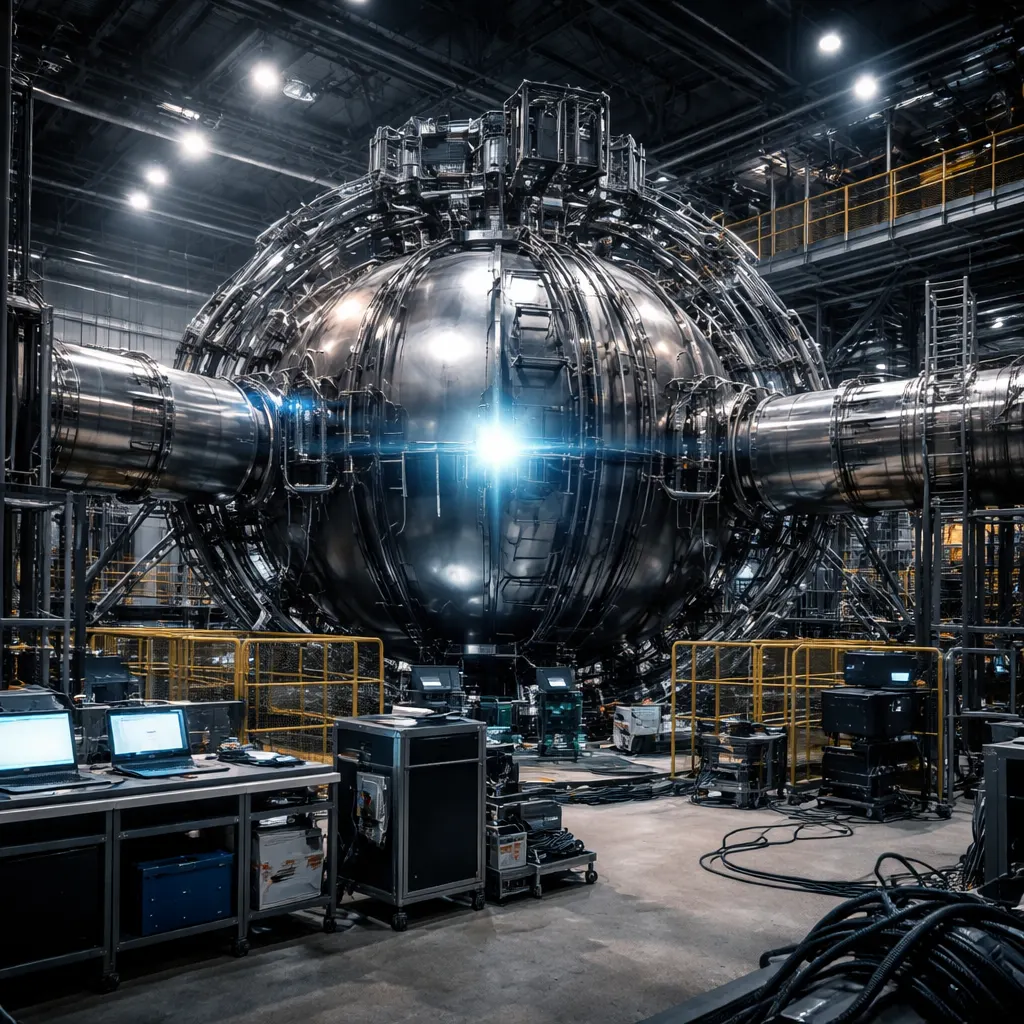
Type One Energy, a Tennessee-based startup working to build fusion power plants, announced Tuesday that it secured $200 million in new funding from investors. The Knoxville company, which was founded in 2019, says the Series B round pushes it into the upper tier of capitalized fusion energy firms. The fresh capital should cover roughly half the cost of a 400-megawatt commercial power plant that the company aims to bring online by 2034, according to CEO Christofer Mowry.
The round was led by returning backer Breakthrough Energy Ventures alongside Clutterbuck Capital, with additional investment from Lowercarbon Capital, Siemens Energy Ventures, and SiteGround Capital. Type One had previously secured $82.5 million in an extended Series A, bringing its total disclosed funding to more than $280 million. The startup plans to construct its first two fusion devices at the Tennessee Valley Authority's Bull Run site, while infrastructure consultant AECOM is handling engineering work for Infinity Two, the initial commercial plant. Type One has also licensed high-temperature superconducting magnet technology from rival Commonwealth Fusion Systems, which will form a core element of the reactor design.
Mowry told TechCrunch that Type One's approach keeps capital requirements lower than vertically integrated competitors by functioning as an integrator rather than a manufacturer. The company will design the power plant and its components, then rely on a specialized network of suppliers selected for each project to build them. "The amount of capital that we need to raise to commercialize fusion at Type One is just a different order of magnitude than if you were going to be vertically integrated," Mowry said. He added that the model avoids heavy spending on facilities: "Why would I want to spend on bricks and mortar? I used to run a big nuclear manufacturing company. That's expensive."
The report explains that this integrator model trades manufacturing risk for supplier risk. Outsourcing gives Type One access to partners with deeper expertise in specific areas—AECOM, for instance, employs around 10,000 engineers, a scale the startup will never match, Mowry noted. But integrators sacrifice control compared to in-house teams, as shown by Boeing's struggles with Spirit AeroSystems, which supplied fuselage sections for the 737 and 787. After quality failures including a door plug blowout on an Alaska Airlines flight in 2024, Boeing acquired Spirit to tighten oversight. Type One is wagering that managing integration risk will prove less costly than handling everything internally, Mowry said, because the model lets companies concentrate on their specific strengths in the value chain.
If Type One delivers its first commercial plant by 2034, the company could complete the project using less capital than many competitors, even accounting for one or more future funding rounds, Mowry said. The startup's timeline and cost structure depend on executing a supply-chain strategy that few fusion firms have tested at scale. Whether the integrator playbook can withstand the technical demands of plasma physics and advanced materials remains the central question for investors and partners alike.